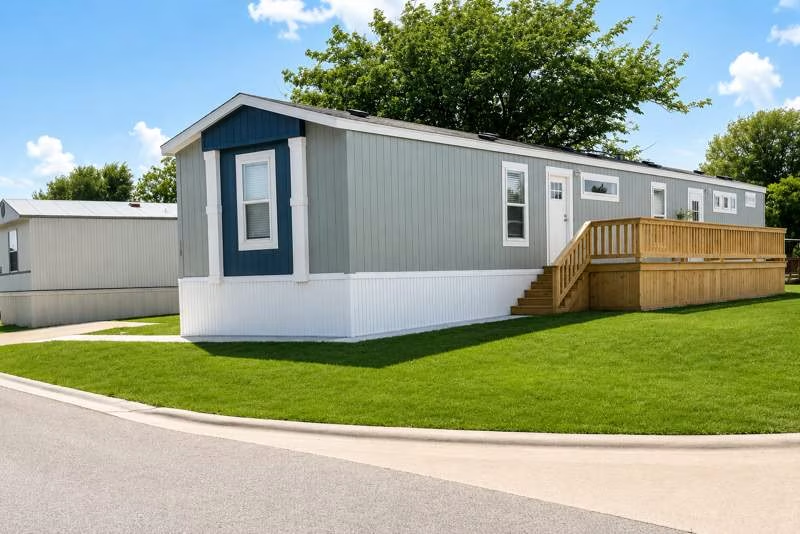
A resident’s decision to renew rarely comes down to one conversation or one amenity. It comes down to what life feels like over many months: whether the streets are cared for, questions receive a response, neighbors respect the community, and housing costs remain manageable. This case study of resident retention improvements looks at how community-focused operations can turn those everyday experiences into stronger long-term residency.
For manufactured home communities, retention is more than a performance metric. When residents stay, relationships grow stronger, homes and lots are more consistently cared for, and the neighborhood becomes a place where people feel known. That stability matters deeply to families, working adults, first-time homeowners, and anyone looking for an attainable home without giving up a real sense of community.
The retention challenge: Good housing needs visible care
A well-located community with affordable homes may attract inquiries, applications, and move-ins. But a move-in is only the start of the resident relationship. If a resident encounters unclear expectations, delayed maintenance follow-up, neglected common areas, or limited communication after arrival, the value of that home can begin to feel less certain.
In this representative case study, community leadership identified a familiar pattern: residents appreciated attainable housing and convenient locations, but renewal decisions were being influenced by day-to-day friction. Some residents did not know the best channel for a maintenance concern. Others wanted more visibility into property improvements. Newer residents needed a clearer understanding of community standards, payment options, and available support.
The goal was not to persuade residents to stay through a single promotion. It was to create a more dependable experience from application through renewal.
Case study resident retention improvements began with listening
The first change was simple but meaningful: management made resident feedback easier to collect and more useful to act on. Conversations during office visits, service requests, renewal outreach, and community events revealed recurring themes. Residents valued clean grounds, safe-feeling streets, respectful neighbors, and a management team that followed through.
Those preferences are not surprising, but they are easy to understate. A new light along a dark walkway or a prompt answer about a billing question may seem operationally small. To a resident deciding whether their household can build a future in a community, those details signal care and reliability.
Rather than treating feedback as a collection of isolated complaints, management grouped concerns into practical categories: property appearance, maintenance communication, safety and lighting, resident information, and community connection. This helped the team distinguish between a one-time issue and a recurring experience that could affect multiple households.
What changed when feedback had an owner
Each category needed a clear owner and a reasonable response process. A resident should not have to repeat the same concern to several people or wonder whether anyone received it. Assigning responsibility did not mean every request could be resolved immediately. Budget, vendor availability, weather, and the scale of a project all affect timing.
It did mean residents could receive an honest update. When a repair required additional time, management communicated the next step. When a larger improvement was planned, residents were told what was changing and why. Direct communication helped replace uncertainty with confidence.
Property standards became part of the resident experience
Residents judge a community long before they enter the office. They see road conditions, landscaping, signage, lighting, common areas, and the appearance of neighboring homes. Consistent property upkeep supports pride in the neighborhood and reinforces that community rules are applied with respect.
In this case, leadership focused on visible, high-impact improvements rather than trying to address every project at once. Priorities included routine grounds care, attention to lighting, clearer community signage, and planned infrastructure work where needed. The approach recognized an important trade-off: major improvements can be disruptive in the short term, especially if equipment, crews, or temporary access changes are involved. Residents were more understanding when they knew what to expect and saw steady progress.
A clean, cared-for property also supports resident-to-resident accountability. Most people want to live near neighbors who value their surroundings. Clear standards, delivered consistently and professionally, help protect that shared expectation without making the community feel impersonal or overly restrictive.
Better communication reduced avoidable frustration
Many retention problems begin as communication problems. A payment deadline, maintenance procedure, policy reminder, or construction update can create unnecessary concern if residents receive information late or cannot find it when they need it.
The community strengthened its communication around the moments that matter most: move-in, service requests, rent payment, policy questions, planned improvements, and renewal. Residents received clear guidance on how to reach the management team and how to use available digital self-service options. An online resident portal gave households a convenient way to manage rent payments and handle key account tasks without waiting for office hours.
Digital tools are helpful, but they are not a substitute for people. Some residents prefer phone calls or in-person support, while others want to complete a task quickly online. A retention-minded approach makes room for both. The point is not to force every resident into one channel. It is to make getting help straightforward.
Renewal outreach started before the deadline
Waiting until the end of a lease or agreement to ask about renewal leaves little time to resolve a concern. In this case, management began renewal conversations earlier. The goal was not to pressure residents. It was to ask a practical question: What would help make the next year here a good one?
Early outreach created time to address issues such as a pending repair, a question about housing options, or uncertainty about community updates. It also gave long-tenured residents a chance to share what was working well. Those conversations offered valuable insight that no dashboard can fully capture.
Community connection gave residents another reason to stay
Affordable housing is essential, but people also want to feel comfortable where they live. A welcoming neighborhood can make a meaningful difference for a family with children, a worker returning home after a long shift, or a resident beginning their path to homeownership.
Community connection does not require a full calendar of large events. In many cases, small, consistent moments are more effective: a well-used clubhouse, seasonal gatherings, a helpful welcome for new residents, or simply an onsite team that knows people by name. These moments reinforce that a community is not just a collection of home sites.
Medallion Communities approaches this responsibility as community stewardship. The focus is on pairing attainable housing with visible care, attentive management, and neighborhoods where residents can embrace the spirit of community.
How to measure retention without losing the human story
Retention rates and renewal percentages matter, but they should be read alongside the experiences behind them. A community may see renewal interest improve after property upgrades, yet still need to address slow service communication. Another may receive strong feedback about its management team while facing a challenge with aging infrastructure.
A useful review combines quantitative and qualitative signals. Management can track renewal decisions, move-out reasons, service-request response patterns, rent payment behavior, and resident feedback themes. Looking at these signals together helps teams avoid false conclusions. For example, a resident who moves may be relocating for work or family reasons, not leaving because of dissatisfaction.
The most helpful question is not simply, “Did residents stay?” It is, “What experience are residents having while they are here?” That question leads to action that protects both retention and quality of life.
Retention is earned in the ordinary moments
The strongest resident retention improvements are rarely flashy. They are built through clean shared spaces, a returned call, a clear update, a safe route home, and a management team that treats each concern as part of the larger community experience.
For residents, those actions create something more valuable than a short-term housing solution: a place that feels stable, welcoming, and worth calling home. For community teams, the next opportunity may be as close as the next resident conversation. Listen carefully, follow through visibly, and let everyday care speak for itself.