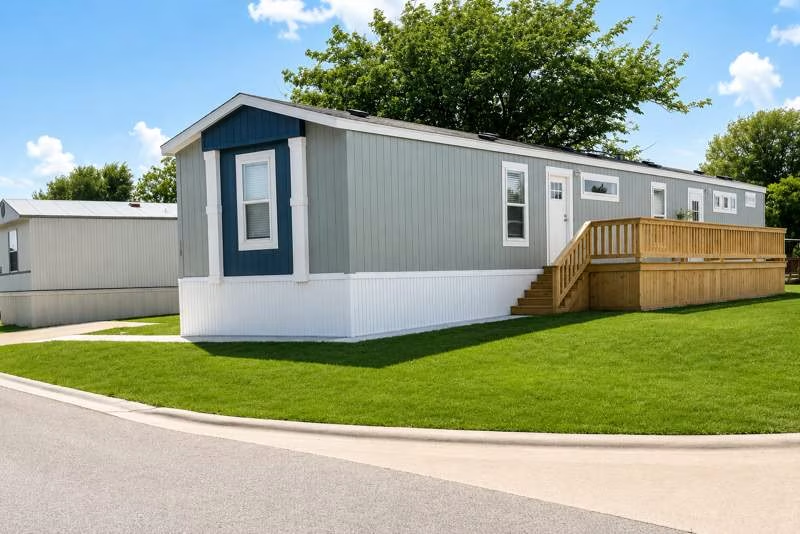
When people compare a manufactured home community vs HOA neighborhood, they are usually asking a practical question, not a theoretical one: where will my money go further, and where will daily life feel easier? That is the right place to start. Housing choice is not just about square footage or curb appeal. It is about monthly costs, how rules are enforced, how neighbors live together, and whether the community feels like a place you can settle into with confidence.
For many households, the comparison is closer than it first appears. Both options can offer shared standards, neighborhood amenities, and a sense of order. But they often get there in very different ways, and those differences matter.
Manufactured home community vs HOA neighborhood: the biggest difference
The clearest difference between a manufactured home community vs HOA neighborhood is how the housing model is set up. In a traditional HOA neighborhood, buyers usually purchase a site-built home and the land beneath it, then pay HOA dues to support common areas and enforce community rules. In a manufactured home community, residents may rent a home, buy a home in the community, or in some cases place a home they already own on a leased homesite.
That structure changes the financial picture right away. In an HOA neighborhood, the largest cost is usually the mortgage, followed by taxes, insurance, maintenance, and HOA dues. In a manufactured home community, residents are often choosing a more attainable path to housing, with lower entry costs than many site-built neighborhoods. Depending on the setup, monthly costs may include home payment or rent, homesite rent, utilities, and community-related fees.
Neither model is automatically better. The right fit depends on whether you want a lower barrier to entry, how much upkeep you want to handle, and how important traditional land ownership is to you.
Cost is not just the sticker price
This is where many buyers and renters make the wrong comparison. They look at a home price and stop there. What matters more is the full monthly picture.
HOA neighborhoods can look appealing on paper, especially if the home itself checks every box. But the total cost often includes mortgage principal and interest, property taxes, homeowners insurance, HOA dues, repair costs, lawn care, and the steady drip of maintenance that comes with a site-built house. Even well-run HOA communities can become expensive if dues rise or if special assessments are added for major repairs or neighborhood projects.
A manufactured home community often appeals to budget-conscious households because the cost structure is more straightforward. Residents are usually looking for predictable housing costs and a neighborhood environment without stretching to the limit. For first-time buyers, working families, retirees, and renters who want more space than an apartment can offer, that matters.
The key is to ask better questions. What is included each month? What is separate? How often do costs change? What maintenance responsibilities stay with the resident, and what is handled by community management? A lower purchase price means less if the rest of the arrangement is unclear. A higher monthly number may still be the smarter choice if it brings stability, services, and less surprise spending.
Rules, standards, and the way they feel in real life
People often assume rules are stricter in HOA neighborhoods. Sometimes they are. But the bigger issue is how rules are written, communicated, and enforced.
An HOA usually operates through governing documents, dues, boards, and enforcement processes. That can work well when leadership is organized and responsive. It can also frustrate residents if rules feel inconsistent, overly technical, or disconnected from day-to-day reality. Anyone who has heard stories about approval battles over fences, paint colors, or parking knows this can become a real quality-of-life issue.
A professionally managed manufactured home community also has rules and standards, and that is not a negative. Good community standards protect everyone. They support cleaner streets, safer shared spaces, better curb appeal, and a more respectful environment between neighbors. The difference is that strong community management often has a more direct role in operations. Residents are not guessing who to contact or waiting on a volunteer board to sort out urgent concerns.
That distinction matters if you value responsiveness. Clear expectations paired with attentive management tend to create a more stable living experience than rules alone.
Maintenance and responsibility look different
One of the most overlooked parts of the manufactured home community vs HOA neighborhood conversation is maintenance.
In an HOA neighborhood, many buyers assume the dues cover more than they actually do. In some cases, the HOA maintains only common areas like entrances, green space, or a pool. The homeowner is still responsible for the house, the roof, the yard, the driveway, and most repairs. That is manageable for some households, but it can become overwhelming for others, especially if time and budget are already tight.
In a manufactured home community, responsibilities depend on whether you are renting a home, buying a home in the community, or bringing in your own home. Still, the appeal is often practical: residents can enjoy a neighborhood setting with management oversight of the broader community environment. Well-maintained roads, lighting, common spaces, and infrastructure are not small details. They shape how a place feels every day.
This is one reason well-run communities are changing perceptions. When the streets are cared for, the grounds are clean, and management addresses issues quickly, residents experience what they should expect from any neighborhood: pride, consistency, and peace of mind.
Amenities and belonging are not exclusive to HOAs
HOA neighborhoods often market themselves around amenities, and that can be attractive. Pools, playgrounds, walking areas, and clubhouses all add value if residents actually use them. But amenities are only part of the story.
Many people are really looking for a neighborhood feel. They want a place where children can play, neighbors recognize each other, and shared spaces feel welcoming rather than neglected. A manufactured home community can offer exactly that, especially when the operator treats community life as part of the housing experience rather than an afterthought.
That is where management quality becomes a deciding factor. A community can have nice features on paper and still feel disconnected. On the other hand, a community with modest amenities and strong day-to-day stewardship can feel more livable, more neighborly, and more secure.
For residents who want affordability without giving up a sense of belonging, that balance is often the real advantage.
Who each option tends to fit best
An HOA neighborhood may be a strong fit for households committed to traditional homeownership, especially those who want a site-built home and place high value on owning both home and land. If the budget is there and the dues are reasonable, it can be a solid long-term choice.
A manufactured home community often makes more sense for households focused on attainable housing, predictable monthly costs, and a community-oriented setting. That includes renters who want more privacy than apartment living, buyers entering homeownership for the first time, and homeowners who already own a manufactured home and need a well-kept place to move it.
This is not a lesser choice. It is a different choice, and for many households it is the more realistic one. Affordability should not require giving up cleanliness, safety, or pride in where you live. Communities that invest in management, infrastructure, and resident experience prove that every day.
Questions to ask before you choose
Before deciding between a manufactured home community vs HOA neighborhood, spend less time on assumptions and more time on specifics. Ask for the full monthly cost breakdown. Ask what rules residents actually deal with most often. Ask who handles maintenance issues and how quickly problems are resolved. Visit at different times of day. Look at the condition of streets, lighting, common areas, and home exteriors.
Most of all, pay attention to whether the place feels cared for. A neighborhood can have attractive signage and still lack follow-through. A community can be modest and still feel welcoming, organized, and stable. That difference becomes clear once you see how the property is managed and how residents live in it.
At Medallion Communities, that belief shapes the standard: affordable housing should still come with professionalism, strong upkeep, and a real sense of community. Because when people are choosing where to live, they are not just comparing properties. They are choosing the kind of everyday life they want to build.
The best housing decision is rarely the one with the flashiest label. It is the one that fits your budget honestly, supports your routine, and feels like home when you pull in at the end of the day.